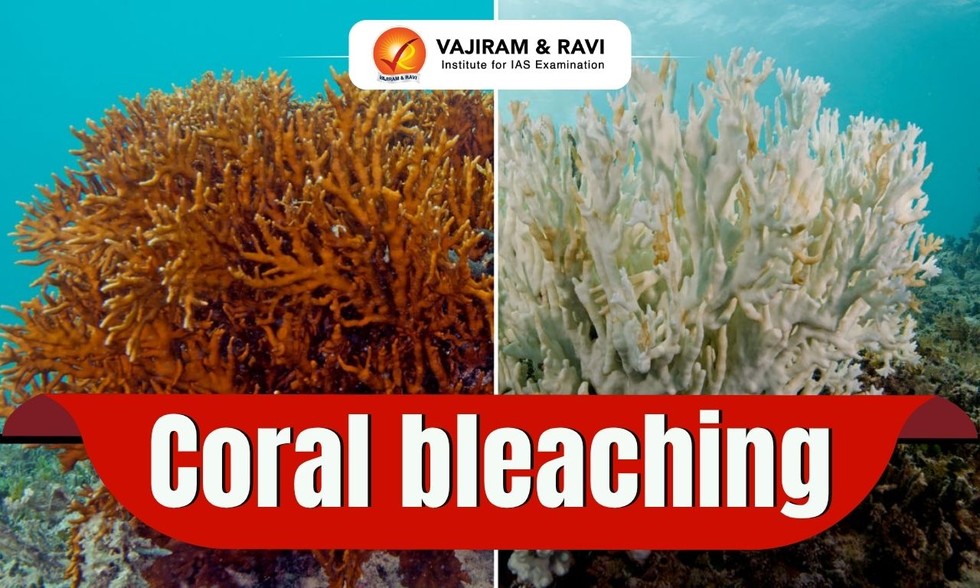
About Coral Bleaching:
- It happens when corals experience stress in their environment due to changes in temperature, pollution or high levels of ocean acidity.
- Process of Coral Bleaching:
- Under stressed conditions, the zooxanthellae or food-producing algae living inside coral polyps start producing reactive oxygen species, which are not beneficial to the corals.
- So, the corals expel the colour-giving zooxanthellae from their polyps, which expose their pale white exoskeleton, giving the corals a bleached appearance.
- This also ends the symbiotic relationship that helps the corals to survive and grow.
What Causes Coral Bleaching?
- Change in Ocean Temperature: Increased Ocean temperature caused by climate change is the leading cause of coral bleaching.
- Runoff and Pollution: Storm generated precipitation can rapidly dilute ocean water and runoff can carry pollutants, which can bleach near shore corals.
- Overexposure to sunlight: When temperatures are high, high solar irradiance contributes to bleaching in shallow water corals.
- Extremely low tides: Exposure to the air during extremely low tides can cause bleaching in shallow corals.
What are Corals?
- Corals are marine invertebrates or animals not possessing a spine.
- Each coral is called a polyp and thousands of such polyps live together to form a colony, which grows when polyps multiply to make copies of themselves.
- Corals share a symbiotic relationship with single-celled algae called zooxanthellae.
- The algae provide the coral with food and nutrients, which they make through photosynthesis, using the sun’s light.
- In turn, the corals give the algae a home and key nutrients. The zooxanthellae also give corals their bright colour.