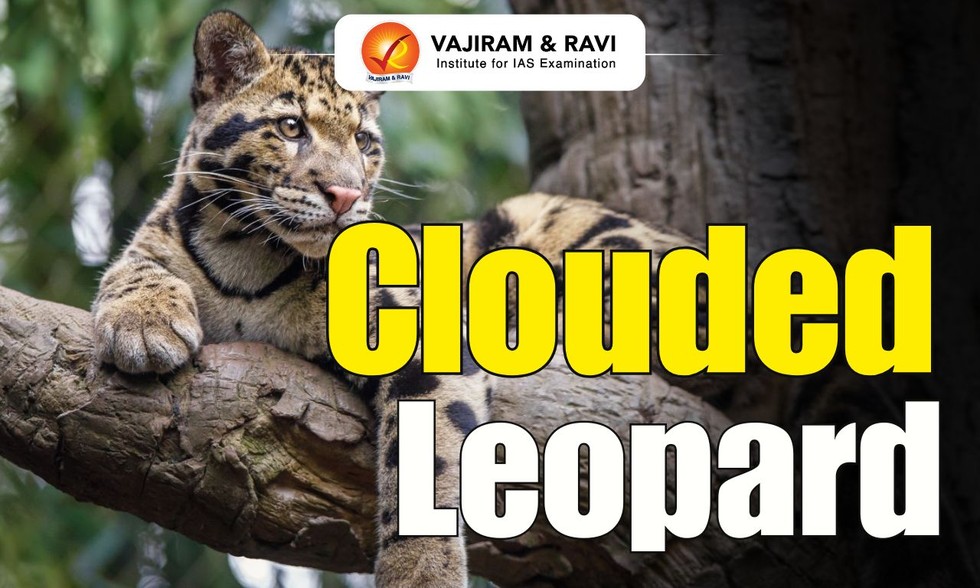
About Clouded Leopard:
- It is a wild cat inhabiting dense forests of the Himalayas through mainland Southeast Asia into South China.
- There are two species of clouded leopards:
- The clouded leopard (Neofelis nebulosa), found on the mainland of southeastern Asia, and the Sunda clouded leopard (Neofelis diardi), found on the islands of Sumatra and Borneo.
- Distribution:
- It is found from Nepal, Bangladesh, and India through Indochina to Sumatra and Borneo, and northeastward to southern China.
- In India, it is found in Sikkim, northern West Bengal, Meghalaya, Tripura, Mizoram, Manipur, Assam, Nagaland, and Arunachal Pradesh.
- Habitat:
- They prefer to live in lowland tropical rainforests.
- However, they can also be found in dry woodlands and secondary forests, and in Borneo.
- Features:
- It is named after the distinctive ‘clouds’ on its coat – ellipses partially edged in black, with the insides a darker colour than the background colour of the pelt.
- It has an exceptionally long tail for balancing, which can be as long as the body itself, thick with black ring markings.
- They are arboreal and nocturnal inhabitants.
- Conservation Status:
- IUCN Red List: Vulnerable
Key Facts about Clouded Leopard Conservation Action Plan:
- It is prepared under the Government of India–GEF–UNDP initiative.
- It provides a comprehensive framework for securing habitats, restoring forest connectivity, strengthening scientific monitoring and empowering local communities for conservation of the species.
- Key components: Identification of 14 priority conservation landscapes across Northeast India, along with landscape-scale habitat restoration and corridor conservation to strengthen connectivity between forest habitats.
- The CAP provides for standardised scientific monitoring through camera traps, occupancy surveys, genetics and environmental DNA (eDNA).
- It also encourages transboundary cooperation with neighbouring range countries for coordinated conservation of the species across its range.