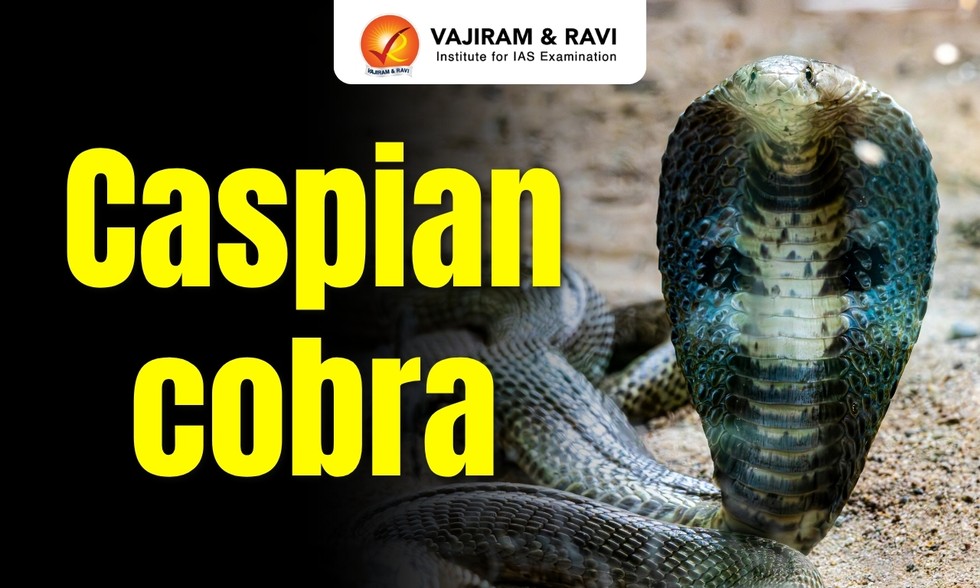
Researchers have documented the first confirmed snakebite envenomation and subsequent human deaths in India caused by the venomous Caspian cobra (Naja oxiana).
About Caspian Cobra:
It is the most venomous cobra in the world.
It is a species of venomous snake in the family Elapidae.
Other names: It is also called the Central Asian cobra, ladle snake, Oxus cobra, or Russian cobra.
Habitat: It thrives in arid and semi-arid regions, including rocky hillsides and scrublands.
Distribution: It is native to Central Asia.
It is found in parts of Turkmenistan, Uzbekistan, Kyrgyzstan, Tajikistan, the Fergana Valley, north and east Afghanistan, northeastern Iran, the northern half of Pakistan from the Kashmir region east to the state of Himachal Pradesh in India, and in southwestern Tajikistan.
Features:
It is slightly shorter than the Indian cobra.
It has long cervical ribs capable of expansion to form a hood. It has no hood marking, just a plain colour instead.
Its coloration can vary from light brown to dark brown or even black, sometimes with a faint banding pattern.
Behavior: These snakes are good climbers and able swimmers.
Diet: These are carnivores and prey on small mammals, amphibians, and birds.
Hibernation: They hibernate from late September or late October to late March-April.
Dear Student,
You have still not entered your mailing address. Please enter the address where all the study materials will be sent to you. (If applicable).