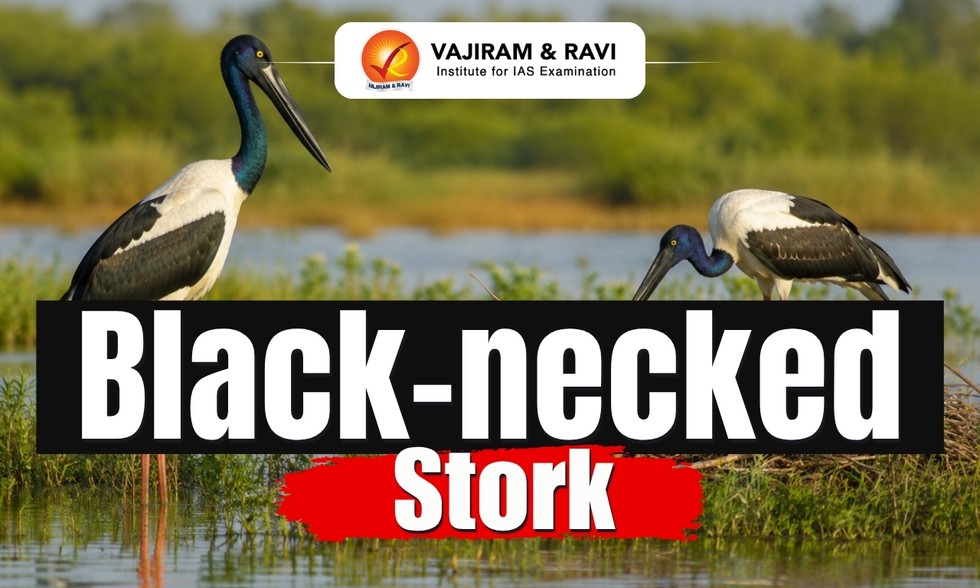
About Black-necked Stork:
- It is a tall long-necked wading bird in the stork family.
- Appearance: Adult black-necked storks have heavy bills and a dramatic combination of white and iridescent black plumage.
- The male and female birds look alike but female is distinguished by its yellow eye.
- Distribution: It is distributed in the Indian Subcontinent, Southeast Asia and Australia.
- Habitat: They inhabit wetlands, such as floodplains of rivers with large shallow swamps and pools, and deeper permanent bodies of water.
- Features of Black-necked Stork:
- It is generally solitary and non-migratory.
- They can also be highly territorial, particularly when water levels fall and food becomes scarce.
- Diet: It is a generalist carnivore with a varied diet. It feeds on fish, frogs, water birds, snakes, aquatic insects, crustaceans and mollusks.
- Threats: Habitat destruction, the draining of shallow wetlands, disturbance at nests, overfishing, pollution, collision with electricity wires, and hunting.
- Conservation Status:
- IUCN status: “Near Threatened”.
- Wild Life (Protection) Act, 1972: Schedule II