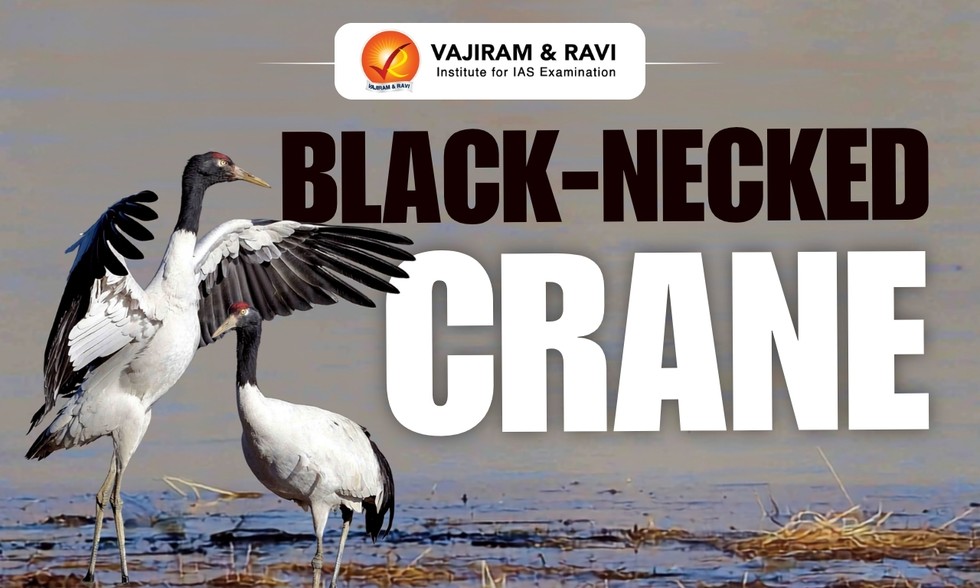
About Black-necked Crane:
- It is classed as a medium-sized member of the crane family.
- Other Names: It is locally is known as “cha thung-thung” in Ladakh and “thungdung karma” in Arunachal Pradesh.
- Appearance: It has a largely whitish-grey body contrasted by a jet-black head and upper neck, splashes of red around the eye, and long, elegant legs built for wading through alpine bogs.
- Distribution: High altitude marshes and lakes of Tibetan Plateau (Tibet, Qinghai, Xinjiang, Gansu), Sichuan (China), and eastern Ladakh (India).
- A small wintering population is also found in Sangti and Zimithang valleys of Arunachal Pradesh in India.
- Breeding: The main breeding sites include the Changthang Cold Desert Wildlife Sanctuary, especially the wetlands of Hanle, Tso Kar, Nyoma, and nearby marshes.
- Cultural Significance: They hold a special place in Ladakh’s Buddhist culture. They are regarded as sacred birds and symbols of peace, purity and good fortune.
- Threats: Increasing human use of areas surrounding wetlands, expansion of linear infrastructure, growing tourism activities, habitat degradation, and the impacts of climate change.
- Conservation Status:
- IUCN: Near Threatened
- CITES: Appendices I
- Wild Life (Protection) Act, 1972: Schedule I.