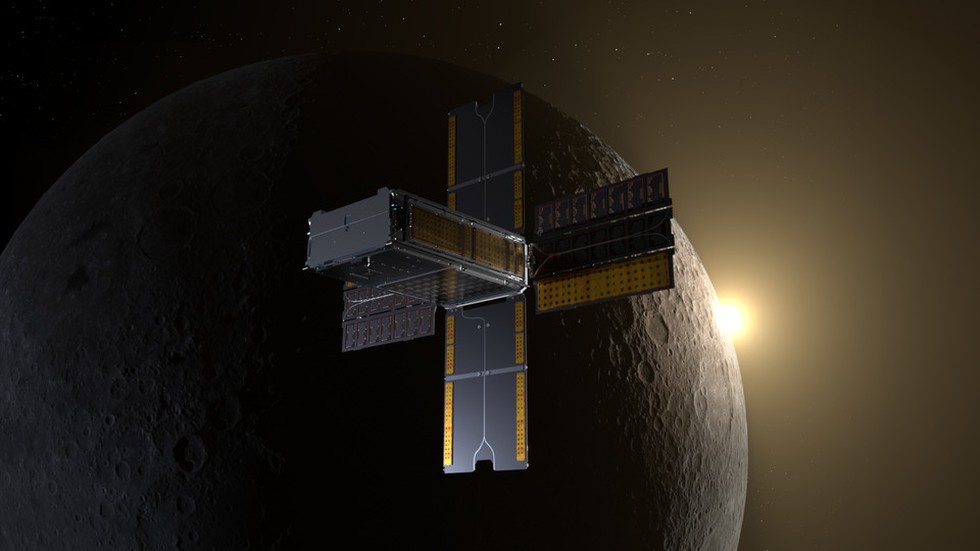
About BioSentinel Mission:
- It is a six-unit (6U) CubeSat launched in 2022.
- It was developed by the NASA Ames Research Center, California, USA.
- It is the first biological CubeSat developed to travel beyond Low Earth Orbit (LEO).
- It was selected as one of the secondary payloads – and the sole biological experiment – to have the rare opportunity to catch a ride to deep space on Artemis I.
- Objectives:
- To develop the capability to support biological organisms in deep interplanetary space
- To characterize the deep space radiation environment and its effects on biological organisms
- Components:
- It is composed of two sections, one containing the scientific payloads, and a spacecraft bus equipped with solar panel arrays, batteries, micropropulsion system, star tracker navigation system, transponder, antennas, and command and data handling systems.
- The two payloads are the microfluidic-based BioSensor instrument and a radiation detector.
- The BioSensor instrument carried the budding yeast S. cerevisiae to assay biological responses to accumulated doses of deep space radiation.