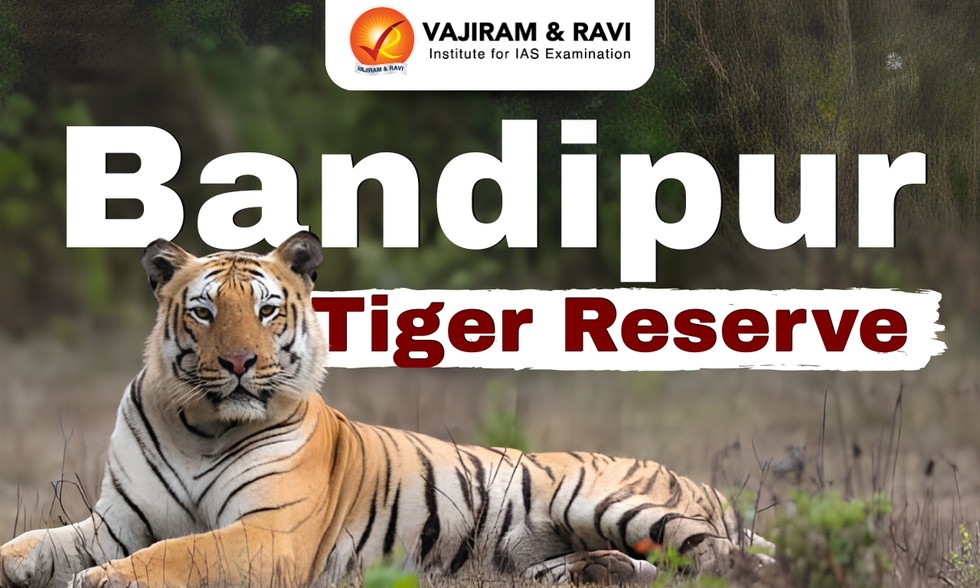
About Bandipur Tiger Reserve:
- It is situated in the Mysore and Chamarajanagar revenue districts of southern Karnataka.
- It is located at the tri-junction area of the States of Karnataka, Tamil Nadu, and Kerala.
- Geographically, it is an “ecological confluence” of the Western and Eastern Ghats.
- It was once a hunting ground for the rulers of the neighbouring kingdom of Mysore.
- It is part of the larger Nilgiri Biosphere Reserve, which is recognized as a UNESCO World Heritage Site.
- BTR is surrounded by:
- Nagarahole Tiger Reserve (Tamil Nadu) in the North West (Kabini Reservoir separates the two).
- Mudumalai Tiger Reserve (Tamil Nadu) in the South.
- Wayanad Wildlife Sanctuary (Kerala) in the South West.
- Rivers:
- It is surrounded by River Kabini in its north and River Moyar in its south.
- The Nugu River runs through the reserve.
- Himavad Gopalaswamy Betta Hill is the highest point in the park.
- Climate: It has a typical tropical climate with distinct wet and dry seasons.
- Vegetation: The park has various biomes, including dry deciduous forests, moist deciduous forests, and shrublands.
- Flora:
- It supports a wide range of timber trees, including teak wood, rosewood, sandalwood, and a variety of bamboo.
- There are also several notable flowering and fruiting trees and shrubs including Indian gooseberry, kadam tree, golden shower tree.
- Fauna:
- It is home to mammals such as the Bengal tiger, gaur, sloth bear, golden jackal, dhole, four-horned antelope, etc.
- It is a shelter for the largest population of wild Asian elephants in South Asia.
- It is home to over 200 species of birds, among which the Indian peafowl is the most commonly spotted
- Other species of birds include honey buzzards, redheaded vultures, Indian vultures , etc.