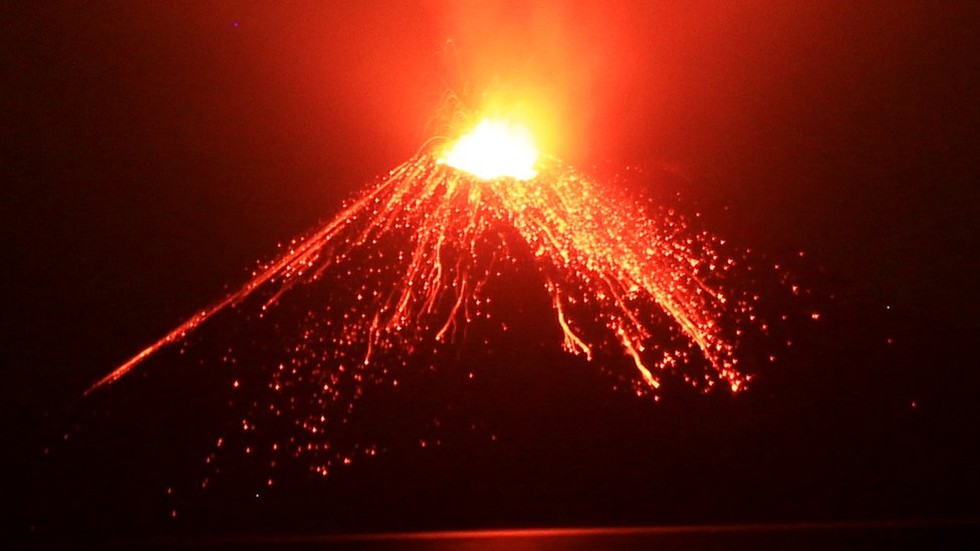
About Anak Krakatau Volcano:
- Location: It is a stratovolcano located in the Sunda Strait, between Java and Sumatra in Indonesia.
- It is a part of the Ring of Fire, a chain of volcanoes in the Pacific Ocean.
- History:
- Anak Krakatau, or "child of Krakatau", is linked to the famed Krakatau, whose 1883 eruption triggered a period of global cooling.
- It emerged from the sea in 1927.
- Over the following years, frequent strombolian eruptions resulted in the growth of the volcano.
- It sits above multiple magma chambers.
- In 2018, an eruption led to the collapse of the southwestern flank of the volcano, with the resulting landslide generating a tsunami.
What is Stratovolcano?
- It is also called a composite volcano, typically a steep-sided, symmetrical cones built of alternating layers of lava flows, volcanic ash, and other eruptive products.
- They are typically found above subduction zones, and they are often part of large volcanically active regions, such as the Ring of Fire that frames much of the Pacific Ocean.
- Stratovolcanoes comprise the largest percentage (~60%) of the Earth’s individual volcanoes.
- They are formed from viscous, sticky lava that does not flow easily.
- The lava therefore builds up around the vent, forming a volcano with steep sides. Stratovolcanoes are more likely to produce explosive eruptions due to gas building up in the viscous magma.