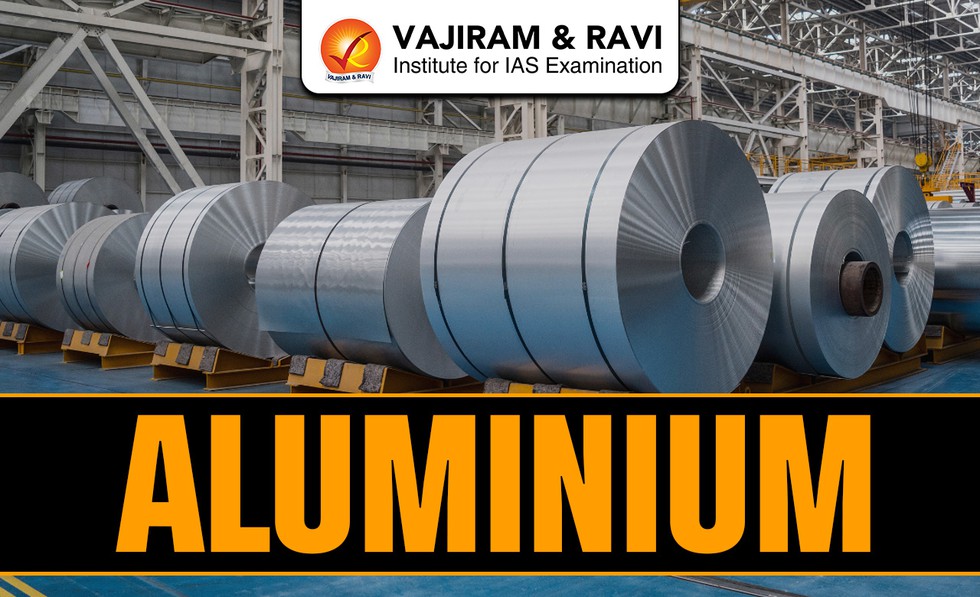
New research has found aluminium can be made to behave in the same way that makes transition metals such as palladium, rhodium, and platinum.
About Aluminum:
It is a chemical element with symbol Al and atomic number 13.
It is classified as a post-transition metal.
Aluminium Ore derived from bauxite, is one of the most abundant, versatile, and strategically important metals in the world.
The transformation of bauxite into aluminium is a two-stage industrial process:
Bayer Process: The raw bauxite is first crushed and treated with sodium hydroxide to separate aluminum hydroxide. This is then calcined (heated strongly) to produce alumina (Al₂O₃).
Hall- Héroult Process: The alumina is smelted using electrolytic reduction, requiring enormous amounts of electricity, which makes aluminium one of the most energy-intensive metals to produce.
Properties of Aluminium:
It is a hard, strong, silvery-white metal with low density.
It has high thermal conductivity, excellent corrosion resistance.
It has high malleability and ductile property.
Lightweight & corrosion-resistant: Ideal for transportation and construction.
Recyclable: Retains its original properties and requires only 5% of the energy compared to primary production.
Applications of Aluminium
Transport: Aircraft, automobiles, ships, and rail coaches.
Household & Packaging: Utensils, appliances, and aluminium foils.
Infrastructure: Doors, windows, screens, and cladding.
Electrical: Good conductor, used in transmission lines.
Strategic Applications: Defence, nuclear industries, and aerospace.
Dear Student,
You have still not entered your mailing address. Please enter the address where all the study materials will be sent to you. (If applicable).