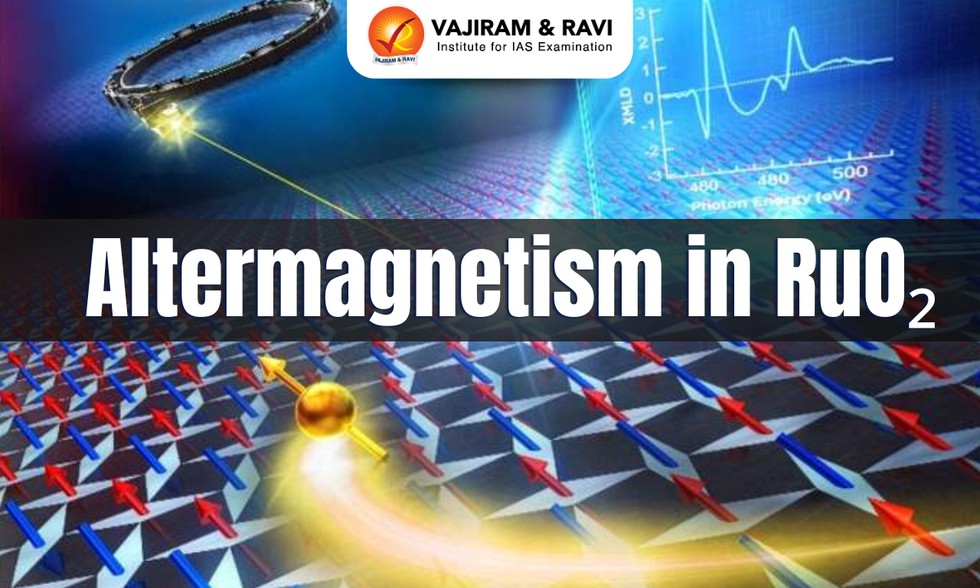
About Altermagnetism and RuO₂ Discovery
- Altermagnetism is recognised as the third fundamental class of magnetism, distinct from ferromagnetism and antiferromagnetism.
- In altermagnetic materials, magnetic moments alternate, but their arrangement follows complex symmetry operations such as rotation and reflection, rather than simple up–down cancellation.
- This leads to a net-zero external magnetic field, similar to antiferromagnets, but with internal electronic spin splitting comparable to ferromagnets.
- Ruthenium dioxide (RuO₂) thin films have been experimentally demonstrated to exhibit true altermagnetism, resolving long-standing global inconsistencies.
- The discovery was made by a joint research team from National Institute for Materials Science (Japan), University of Tokyo, Kyoto Institute of Technology, and Tohoku University, and published in Nature Communications.
- The team fabricated single-orientation (single-variant) RuO₂ thin films on sapphire substrates, ensuring uniform crystallographic orientation, which was crucial for conclusive verification.
- Using X-ray Magnetic Linear Dichroism (XMLD), researchers confirmed spin arrangements where net magnetisation cancels (no N–S poles).
- The study also observed spin-split magnetoresistance, electrically verifying the spin-splitting electronic structure, a key signature of altermagnetism.
- The experimental results were found to be consistent with first-principles calculations of magneto-crystalline anisotropy, strengthening theoretical validation.