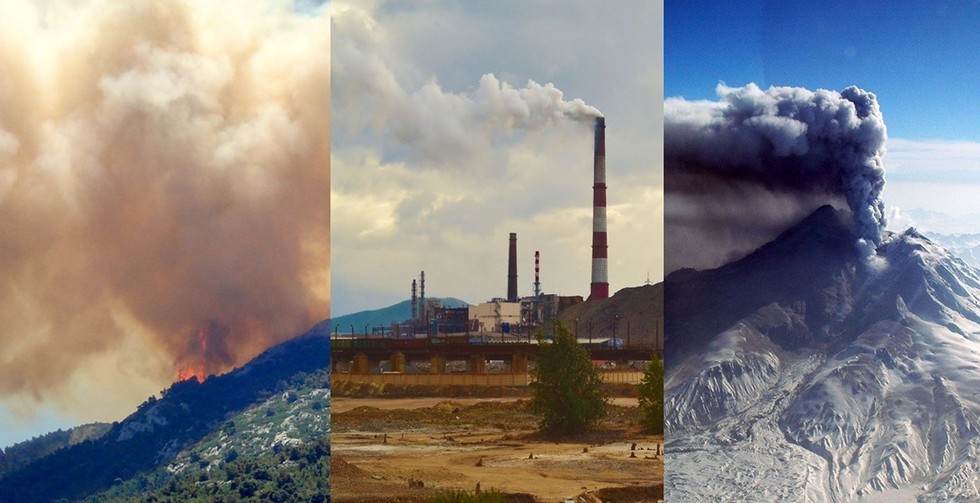
About Aerosols:
- Aerosols are tiny particles suspended in the atmosphere.
- Source: They originate from sources such as desert dust, vehicle emissions, industrial pollution and forest fires.
- Properties:
- Size: Aerosols range in size from a few tens of nanometers to several tens of micrometers.
- These particles can either reflect sunlight back into space or absorb it,
- They are often not or barely visible to the human eye, yet their impact on climate, weather, health, and ecology are significant.
- These particles alter Earth's energy balance and influencing temperatures, cloud formation and rainfall.
- Types:
- Primary Aerosols: Those injected into the atmosphere directly are known as 'primary aerosols'.
- Examples: Sea spray, mineral dust, smoke, and volcanic ash are all primary aerosols.
- Secondary aerosols: These are aerosols which were emitted in another form (e.g. gases), then become aerosol particles after going through chemical reactions in the atmosphere,
- Example: Sulfate aerosols from volcanoes or industrial emissions.
Key Highlights of the Study:
- Scientists classified aerosols into seven categories:
- Pure dust, dust-dominated mixtures, pollution-dominated mixtures, very weakly absorbing, weakly absorbing, moderately absorbing and strongly absorbing aerosols
- Pure dust dominates northern Africa, while Europe and North America are largely characterised by less-absorbing urban and industrial aerosols.
- Strongly absorbing aerosols, which often contain high levels of black carbon, produced the greatest atmospheric warming.
- Very weakly absorbing aerosols had the lowest atmospheric forcing, reflecting more sunlight back into space and producing a much smaller warming effect.
- Tropical regions affected by biomass burning are mainly dominated by strongly absorbing aerosols.
- Black carbon-rich aerosols drive stronger warming.