Why in news?
Mustard is India’s largest indigenous source of edible oil, cultivated across nearly nine million hectares, mainly in Rajasthan, Uttar Pradesh, Madhya Pradesh, Haryana and West Bengal.
However, the crop is increasingly threatened by Orobanche aegyptiaca, a parasitic weed that attaches to mustard roots and siphons off water and nutrients, leading to poor plant growth and reduced seed yields.
What’s in Today’s Article?
- How Orobanche Damages the Crop?
- Why Mustard Matters for India?
- Herbicides as a Possible Control Tool
How Orobanche Damages the Crop?
- Orobanche attaches itself to mustard roots underground and siphons off water, nutrients and carbon.
- This leads to wilting, yellowing, stunted plant growth and ultimately sharp declines in seed yields.
- Because the parasite remains hidden below the soil initially, damage is already extensive by the time it becomes visible.
- Farmers See Sharp Yield Losses
- Farmers report steep yield declines despite following recommended control measures.
- In Haryana’s Sirsa district, yields have fallen from 9–12 quintals per acre earlier to nearly 6 quintals per acre in recent seasons.
- Even herbicide sprays have shown little effect, pushing farmers to reduce mustard acreage in favour of wheat, chickpea and barley.
- Why Infestation Is Spreading Fast?
- Each Orobanche plant produces thousands of tiny seeds that can remain viable in soil for up to 20 years and spread through wind and water.
- Fields repeatedly planted with mustard are especially vulnerable, as irrigation creates ideal conditions for seed germination and rapid underground attachment to crop roots.
- The rising infestation has shaken farmer confidence in mustard, traditionally valued for its low irrigation needs.
- As Orobanche spreads, many farmers are cutting back on mustard cultivation, raising concerns over future domestic edible oil production.
Why Mustard Matters for India?
- Mustard is India’s most important edible oilseed crop, contributing over 4 million tonnes out of the country’s 10.5–10.6 million tonnes of annual indigenous edible oil production.
- It is central to efforts to cut India’s heavy dependence on edible oil imports.
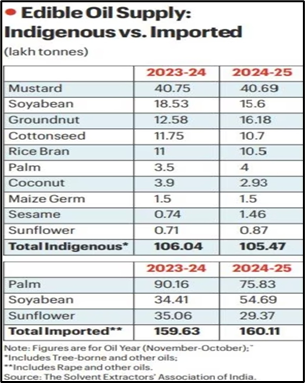
- Reducing Import Dependence - India imports nearly 16 million tonnes of edible oils every year — mainly palm, soybean and sunflower oil — costing $15.9 billion in 2023–24 and $18.3 billion in 2024–25.
- Improving mustard yields is therefore a key national priority to reduce this import bill.
- Rising Disease and Pest Pressure - Mustard’s increasing vulnerability to Orobanche (margoja), along with pests like aphids and fungal diseases such as white rust, leaf blight, stem rot and powdery mildew, has emerged as a serious concern for productivity and farmer confidence.
- Farmers Flag Changing Threat Patterns
- Farmers report that Orobanche infestation is now appearing earlier in the crop cycle and in fertile soils, unlike earlier when it emerged later and mostly in sandy fields.
- This shift signals a growing and more aggressive threat.
- The buildup of long-lasting Orobanche seed banks in soil has increased the weed’s damage potential, enabling early emergence and greater yield losses.
- This has left farmers increasingly uncertain, sowing mustard largely on hope rather than confidence.
Herbicides as a Possible Control Tool
- Chemical control using herbicides such as glyphosate is one possible way to tackle Orobanche.
- However, this approach has major limitations with conventional mustard varieties.
- Why Conventional Herbicides Don’t Work?
- Glyphosate and similar broad-spectrum, non-selective herbicides kill all plants by blocking the EPSPS (5-enolpyruvylshikimate-3-phosphate synthase) enzyme essential for protein formation.
- Applied to normal mustard, they destroy the crop along with the weed.
- At currently recommended low doses, they are also ineffective against Orobanche.
- Role of Herbicide-Resistant Mustard
- A new approach lies in breeding mustard varieties that can tolerate specific herbicides.
- Farmers are testing a hybrid mustard that is resistant to imidazolinone herbicides, allowing selective control of Orobanche without harming the crop.
- The hybrid ‘Pioneer-45S42CL’ can tolerate imazapyr and imazapic herbicides.
- Sold with a compatible herbicide formulation, it requires a single spray after 25 days of sowing and has shown encouraging early results in farmers’ fields.
- GM Mustard as a Future Option
- Researchers have also developed GM mustard lines resistant to glyphosate and other herbicides, offering multiple chemical options and reducing the risk of resistance buildup.
- Given mustard’s strategic importance and the rising weed threat, policymakers face a critical decision on permitting GM crops.
- Any decision, experts argue, should be guided by science and farm economics rather than ideology.

