Why in news?
- In the 1970s and early 1980s, many Western countries faced stagflation, meaning low or negative economic growth along with high inflation.
- For example, the US and UK had negative or very low GDP growth in 1974–75, while inflation remained very high during the same period.
- A similar pattern was seen again between 1979 and 1982, especially in the US, with fluctuating growth and high inflation rates.
- The main cause of stagflation was oil shocks:
- First: After the 1973 Yom Kippur War, when Arab countries imposed an oil embargo.
- Second: After the 1979 Iranian Revolution and the Iran-Iraq conflict.
- Later oil shocks (2008, 2022, 2026) also affected economies, but:
- 2008 caused slow growth without high inflation.
- 2022 led to inflation but not a major recession.
What’s in Today’s Article?
- Understanding Stagflation: Causes and Mechanism
- Is Stagflation a Real Risk Today
- Dealing with Stagflation: Limits and Challenges
Understanding Stagflation: Causes and Mechanism
- Stagflation refers to a situation where high inflation and low or negative economic growth occur together, described as “the worst of both worlds”.
- A combination of "stagnation" and "inflation," famously coined in the 1960s to describe a period of rising prices alongside a sluggish economy.
- Basic Demand–Supply Framework
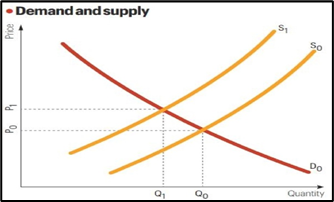
- Prices and output are determined by the interaction of demand and supply curves.
- The equilibrium point is where quantity demanded equals quantity supplied (P0, Q0).
- Normally, changes in supply occur due to price changes, leading to movement along the same supply curve. In contrast, a supply shock shifts the entire supply curve.
- Stagflation arises from negative supply shocks, which reduce production.
- Causes include wars, pandemics, natural disasters, and disruptions in trade or shipping routes. These factors increase input costs and reduce supply.
- Impact on Economy
- The supply curve shifts left (from S0 to S1).
- This leads to:
- Higher prices (P1)
- Lower output (Q1)
Is Stagflation a Real Risk Today
- The possibility of stagflation depends on the magnitude and duration of the supply shock.
- The ongoing US-Israel vs Iran conflict has created a severe shock.
- Unlike 2022 (mainly a price shock), the current crisis is both a price and supply shock, making it more serious.
- The issue is not just high prices but also availability of energy (oil, gas, LPG).
- Shortages can lead to sudden stoppage of industrial activity and long-term economic disruptions.
- Increased Economic Vulnerability
- Compared to the 1970s, India is now more dependent on energy and petrochemical products.
- Fertilisers, LPG, synthetic fibres, and plastics are widely used, increasing vulnerability to energy disruptions.
- Energy disruptions affect multiple industries through supply chains.
- These create complex, non-linear economic impacts, where small disruptions can lead to large economic consequences.
Dealing with Stagflation: Limits and Challenges
- Role of Supply Shock Duration
- The impact of stagflation depends on how long the supply shock lasts.
- If disruptions end quickly, the supply curve can return to normal, avoiding prolonged stagflation.
- Limits of Conventional Policy Tools
- Fiscal and monetary policies can address either:
- Low growth (through spending and lower interest rates), or
- Inflation (through tighter money and higher rates).
- Policy Trade-offs in Stagflation
- Raising interest rates to control inflation can worsen growth and unemployment.
- Stimulating demand through spending or lower rates can increase inflation further when supply is constrained.
- Nature of the Problem
- Stagflation is mainly a supply-side issue, while traditional policies target demand management.
- This makes standard tools less effective.
- Way to Address Stagflation
- The solution lies in restoring disrupted supply chains.
- However, achieving this is difficult and complex.