Why in News?
India has inducted its third nuclear-powered ballistic missile submarine (SSBN), INS Aridhaman, along with the stealth frigate INS Taragiri at Visakhapatnam. There has been no formal announcement of its commissioning.
The quiet induction of INS Aridhaman follows the same pattern as earlier Arihant-class submarines—INS Arihant (2016) and INS Arighaat (2024).
Its addition is significant as it strengthens India’s sea-based nuclear deterrence, a crucial component of the country’s strategic defence capability.
What’s in Today’s Article?
- Induction of INS Aridhaman
- Features of INS Aridhaman
- Origins of India’s Nuclear Submarine Programme
- Future Submarine Plans of India
- India’s Submarine Strength and Operational Capacity
Induction of INS Aridhaman
- India has inducted its third nuclear-powered ballistic missile submarine (SSBN), INS Aridhaman, significantly enhancing its sea-based nuclear deterrence.
- With this induction, India now has three operational SSBNs, marking a major milestone in its strategic capabilities.
- Enhanced Capabilities of the Submarine
- INS Aridhaman is an indigenous SSBN designed to carry a greater number of long-range nuclear-tipped missiles compared to its predecessors—INS Arihant (commissioned in 2016) and INS Arighaat (2024).
- This advancement strengthens India’s ability to maintain a credible deterrent.
- Strengthening India’s Nuclear Triad
- The induction further consolidates India’s nuclear triad, which refers to the capability to launch nuclear weapons from land, air, and sea.
- Land-based systems: Agni series missiles
- Air-based systems: Fighter aircraft like Rafale, Su-30MKI, and Mirage 2000
- Sea-based systems: SSBNs like INS Aridhaman
- India joins a select group of countries—the US, Russia, China, and France—that possess such capability.
- Second-Strike Capability and Deterrence
- India follows a “No First Use” nuclear doctrine, meaning nuclear weapons are intended only for deterrence and retaliation.
- In this context, SSBNs play a critical role by ensuring a second-strike capability.
- Even if an adversary targets India’s land and air bases in a first strike, SSBNs operating stealthily at sea can launch a retaliatory nuclear attack, thereby maintaining credible deterrence.
Features of INS Aridhaman
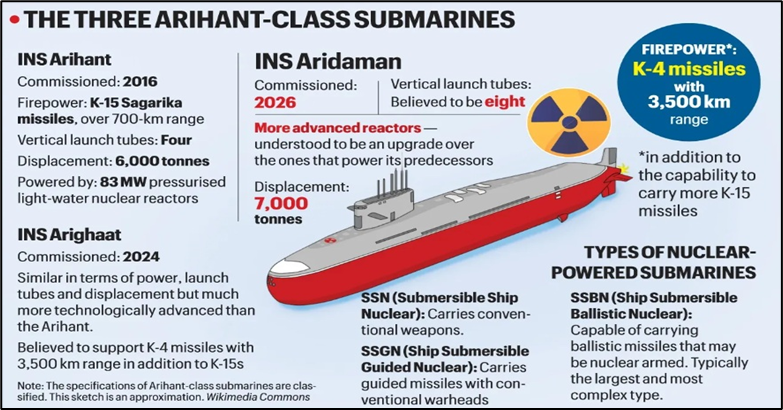
- INS Aridhaman is a 7,000-tonne nuclear-powered submarine equipped with eight vertical launch tubes, nearly double that of its predecessors.
- This allows it to carry a larger number of nuclear-capable missiles.
- It is powered by upgraded nuclear reactors, enabling it to remain submerged for months without surfacing, significantly improving stealth and survivability.
- The submarine can deploy:
- K-15 SLBMs with a range of over 700 km
- K-4 SLBMs with a range of around 3,500 km
- This combination enhances India’s ability to strike targets at varying distances.
- India is also building a fourth SSBN, expected to be larger and capable of carrying more K-4 missiles, further strengthening the country’s sea-based nuclear deterrent.
Origins of India’s Nuclear Submarine Programme
- India’s nuclear-powered submarine project began over three decades ago, involving collaboration between the DRDO, private industry, and technical assistance from Russia.
- The aim was to build an indigenous sea-based nuclear deterrent.
- INS Arihant: The First Milestone
- INS Arihant, launched in 2009 and commissioned in 2016, became India’s first nuclear-powered submarine, giving the country a maritime nuclear strike capability for the first time.
- In 2018, Arihant completed its first deterrence patrol, marking the operationalisation of India’s nuclear triad.
- Later, in October 2022, it successfully launched a submarine-launched ballistic missile (SLBM) in the Bay of Bengal with high accuracy.
- INS Arighaat: Technological Advancement
- The induction of the 6,000-tonne INS Arighaat in 2024 further strengthened India’s nuclear strike capability.
- It is considered more technologically advanced than Arihant, incorporating improved design, engineering, and manufacturing techniques.
- Its construction involved advanced R&D, specialised materials, complex engineering processes, and skilled workmanship, reflecting India’s growing expertise in submarine technology.
- Nuclear Propulsion and Stealth Capability
- Both INS Arihant and INS Arighaat are powered by 83 MW pressurised light-water nuclear reactors, enabling them to remain submerged for long durations and operate with greater stealth compared to conventional diesel-electric submarines.
- Together, these submarines form the backbone of India’s sea-based nuclear deterrent, enhancing survivability, stealth, and second-strike capability as part of the country’s broader nuclear strategy.
Future Submarine Plans of India
- India is expanding its underwater capabilities through multiple initiatives.
- It is pursuing a nuclear-powered attack submarine (SSN) programme, under which two SSNs will be built indigenously, while one submarine will be leased from Russia, expected by 2027–28, to bridge immediate capability gaps.
- Additionally, India is close to finalising the Project-75I submarine deal with Germany, where ThyssenKrupp Marine Systems will collaborate with Mazagon Dock Shipbuilders Ltd to build six advanced conventional submarines with Air Independent Propulsion (AIP) technology in India.
- However, there is still uncertainty regarding the acquisition of three additional Scorpene-class submarines.
India’s Submarine Strength and Operational Capacity
- India currently operates 16 conventional submarines, in addition to its SSBN fleet.
- These include six Kalvari-class submarines built with France’s Naval Group, four Shishumar-class, and seven Kilo (Sindhughosh)-class submarines.
- While the Navy is authorised to maintain a fleet of 18 submarines, about 30% are typically under refit at any given time, reducing the number of operational submarines available.
- In comparison, the United States operates 14 Ohio-class SSBNs and 53 attack submarines, while China has around 12 nuclear submarines, including six nuclear-powered attack submarines, highlighting the capability gap India aims to bridge.