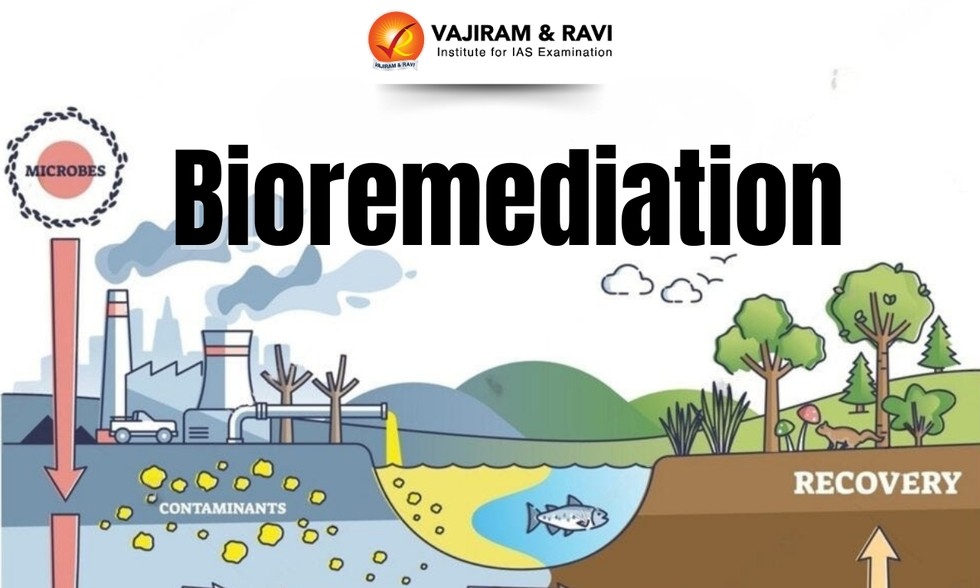
Bioremediation offers a cheaper, scalable, and sustainable alternative, especially in a country like India where vast stretches of land and water are affected but resources for remediation are limited.
About Bioremediation
Bioremediation literally means “restoring life through biology.”
It is the use of living organisms, primarily microorganisms, to degrade environmental contaminants into less toxic forms.
It is used to clean up contaminated soil, air, and water.
It harnesses microorganisms such as bacteria, fungi, algae, and plants to sequester or transform toxic substances such as oil, pesticides, plastics, or heavy metals.
These organisms metabolise these pollutants as food, breaking them down into harmless by-products such as water, carbon dioxide, or organic acids.
In some cases, they can convert toxic metals into less dangerous forms that no longer leach into the soil or groundwater.
Two Broad Types of Bioremediation:
In situ bioremediation, where treatment happens directly at the contaminated site, such as when oil-eating bacteria is sprayed on an ocean spill;
Ex situ bioremediation, where contaminated soil or water is removed, treated in a controlled facility, and returned once cleaned.
Advantages:
It cleans up the environment naturally without the use of toxic chemicals. So, it is an environmentally friendly
It is cost-effective, as extensive equipment and labor are not needed.
It is a recommended method for removing oil stains.
Disadvantages:
It is limited to the compounds which are degradable.
It is not able to remove all kinds of impurities from the contaminated site. Like, some kind of inorganic contaminants cannot be treated with this bioremediation method.
Some heavy metals cannot be completely broken down, resulting in toxic by-products.
Dear Student,
You have still not entered your mailing address. Please enter the address where all the study materials will be sent to you. (If applicable).