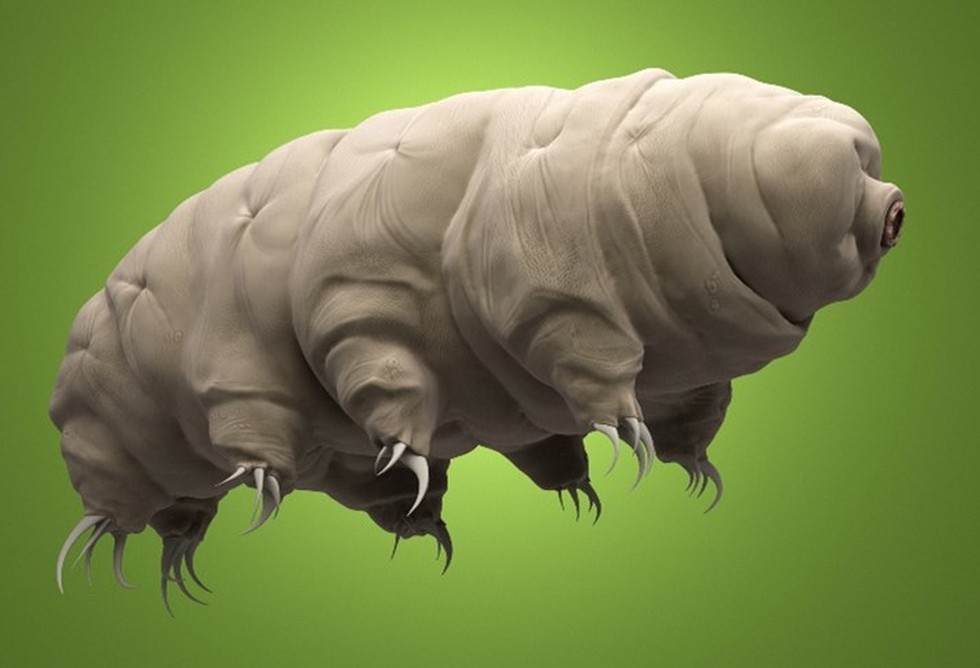
About Actinarctus odissi:
- It is a new species of tardigrade.
- The microscopic creature was discovered in the shallow marine waters of the Bay of Bengal, near the coastal region of Markandi in Odisha.
- The name ‘’odissi’’ was chosen to honour the famous traditional classical dance form originating from Odisha.
- This marks the first time in 43 years that a new member of its elusive genus has been found.
- Features:
- It boasts a dome-shaped body surrounded by transparent, wing-like flaps called alae, which are supported by translucent pillars.
- While other species in this genus feature long wings and elaborate internal supports, this new water bear has noticeably shorter lateral wings.
- Its back legs possess simple, un-split sensory organs that are much shorter than those of its cousins.
- It also features blunt-tipped sensory appendages, rather than sharp ones, and its back is uniquely heavily sculptured with tiny, trombone-shaped pillars.
What are Tardigrades?
- Tardigrades, also called ‘’water bears’’ or ‘’moss-piglets’’, are tiny microscopic animals.
- Scientists have identified about 1,300 tardigrade species.
- Tardigrades can be found in almost every habitat on Earth.
- Most species live in freshwater or semiaquatic terrestrial environments.
- Marine tardigrades account for 17% of all known tardigrade species.
- They are short (0.05 mm - 1.2 mm in body length), plump, bilaterally symmetrical, segmented organisms.
- They have four pairs of legs, each of which ends in four to eight claws.
- They feed on the fluids of plant cells, animal cells, and bacteria.
- They are famous for their extraordinary ability to survive extreme environmental conditions.
- They can survive punishing heat, freezing cold, ultraviolet radiation, and even outer space.
- Under unfavourable conditions, they go into a state of suspended animation called the “tun” state—in which the body dries out and appears as a lifeless ball (or tun).
- In this state their metabolism may decline to as little as 0.01 percent of its normal rate.
- Tardigrades can survive as tuns for years, or even decades, to wait out dry conditions.