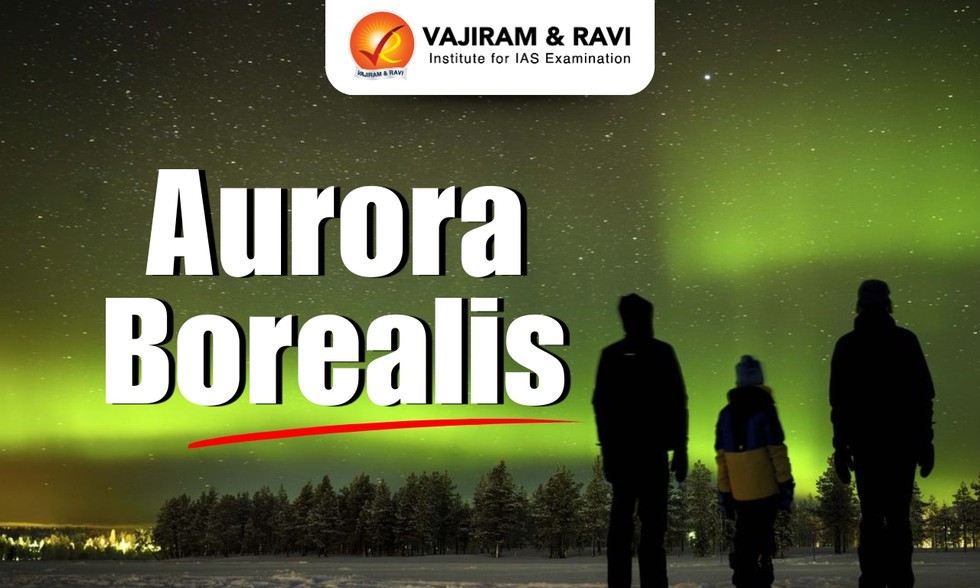
Recently, ‘Aurora Borealis’, more popularly called ‘northern lights’ was expected to be visible in India.
About Aurora Borealis:
It is popularly called as ‘northern lights’.
The phenomenon is called ‘northern lights’ because they are concentrated around the North Pole or the magnetic pole in Earth’s northern hemisphere.
They are frequently seen in Norway, Sweden, Finland, Iceland, Canada, Alaska, and Greenland.
Aurora Borealis’ is the scientific name for these lights in the night sky in the northern hemisphere.
The ones in the southern hemisphere are called ‘Aurora Australis’ or ‘southern lights.’
Formation of Auroras:
It is due to activity on the surface of the Sun.
The star continuously releases a stream of charged particles, mainly electrons and protons, and magnetic fields called the solar wind.
As the solar wind approaches the Earth, it is deflected by the planet’s magnetic field, which acts like a protective shield.
However, some of the charged particles are trapped in the magnetic field and they travel down the magnetic field lines at the north and south poles into the upper atmosphere of the Earth.
These particles then interact with different gases present there, resulting in tiny flashes that light up the night sky.
When solar wind particles collide with oxygen, a green colour light is produced. Interaction with nitrogen produces shades of blue and purple.
Auroras expand to midlatitudes when the solar wind is extremely strong.
This happens when the activity on the Sun’s surface goes up, leading to solar flares and coronal mass ejections (CMEs), which are essentially extra bursts of energy in the solar wind.
In such cases, the solar wind is so intense that it can result in a geomagnetic storm, also known as a magnetic storm — a temporary disturbance of the Earth’s magnetic field.
Dear Student,
You have still not entered your mailing address. Please enter the address where all the study materials will be sent to you. (If applicable).